
Common Myths About Generative AI
Common Myths About Generative AI – Debunked
Cut through the noise and understand what ai can actually do (and not) what can really do.
Generative AI is no longer a discussion – it is a powerful tool we make materials, produces products and solves problems. But there is a lot of confusion with all the publicity. You’ve probably heard things like “AI will replace all human jobs” or “Generic Ai does everything on its own with scratches.”
Let’s move one step back and create different facts from history. In this blog, we blast the most common myths of generic AI – especially those who confuse the traditional, material creators and business leaders in India.

Myth 1: Generative Ai thinks like a human
Truth: Generative AI is not “thinking” – it predicts.
Many people believe that AI tools like chat or Midjourney have their own understanding or intention. But in fact, these models work by analyzing large amounts of data and analyzing predictions based on patterns.
Take, for example, chatgpt – this does not mean what it says. Instead, it predicts what the word will move on depending on the reference. It doesn’t work, the reason, or feels that people are doing it.
Think about it on steroids automatically.
Why it matters: Don’t consider AI as a decision -maker. Use it as a creative accessory – a tool to increase human thinking, not to replace it.
Myth 2: AI produces everything from scratches
Truth: Generative AI creates on the basis of what he has learned.
It is attractive to assume that AI “inventions” the materials completely new ideas or thin air. But that’s not how it works. The generative model is trained on a large dataset – such as books, websites, codbase and artwork – and uses these patterns to generate new variations.
This means that the output is often a remix or resting existing data. It likes to give a skilled copy access to each library in the world – and ask them to write a new poem.
Examples: Tools such as Cibre (music videos are used by the creators of India) or runway ml producing materials that work new – but it is always based on learned styles.
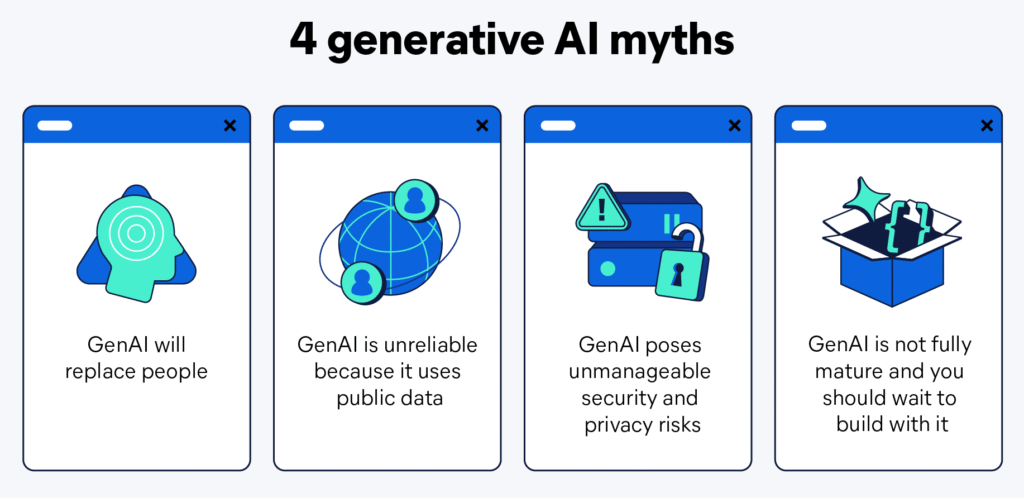
Myth 3: Generative AI will change all creative jobs
Truth: It replaces tasks, not humans.
Yes, some repetitive jobs – such as basic copying, image rays or data introductions – can be shifted. But creativity, strategy and history? Still very human.
In fact, the demand for creative direction, early design and AI-assisted content cures increases. Marks require people who can guide AI to create meaningful, brand -based materials.
Example: Black Pepper Materials as Indian Media Design Uses AI to help their authors – not replace them. AI handles the first draft, but human editors shape the final message.
Myth 4: Generic AI content is always original
Truth: Not always – and this is a legal concern.
Just because AI has produced something doesn’t mean it’s copyright-safe. The generative tools can accidentally reproduce existing content from their training data – especially if this data was not filtered properly.
This is especially relevant when generating commercial material, advertising visual or branding.
Best practice: Always double check the AI-Generative output. Copyscape or originality to detect duplication. Use devices like AI. And never trust AI for the final published work.
Myth 5: You must be a codes to use generative AI
Truth: Most of the equipment is no code and user -friendly.
Those days have come then only developers could use AI. Today’s most important platforms are designed for everyday users – violent, designer, founder, students.
For example:
Canva’s magic design allows you to create a social post using AI.
The description (used by podcasters and video processes) allows you to edit the sound just by editing the text.
Bhashini (an Indian initiative) uses AI for real-time language translation-no-technical skills is needed.
If you can write a sentence, you can use AI.

Myth 6: Ai always gets right
Truth: AI is wrong with confidence – often.
The generative models can secure, but they “sometimes” hallucinations ” – which means they generate false or false information with full confidence.
This makes them risky for facts such as legal documents, medical content or financial writing.
Example of real life: A lawyer in the United States was fined after submitting a legal short name written by Hakk-in as fake litigation was cited. It looked real, but was 100% aimed.
Always fact-check AI content, especially in professional surroundings.
Myth 7: AI understands culture and reference
Truth: Not really – and it’s a big deal in India.
The generative AI can struggle with cultural shades, regional manifestations and reference -specific humor or tone, especially in multilingual countries such as India.
For example, try writing an AI to write a Rajasthani -People’s History or copy the emotional depth of the Hindi movie dialogs – it can get closer, but it doesn’t work locally.
This is why local manufacturers are still necessary. Can AI help with drafts and ideas, but the sound of the material? He is human
Myth 8: Use of AI is expensive
Truth: Many top equipment is independent or affordable.
From students to startups, AI units are available like never before. Some of the most powerful platforms offer free levels:
Chatgpt free gives you access to GPT-3.5.
Bard of Google is open to anyone with Google account.
Leonardo.ai AI provides limited free credit for art generation.
Clamps Face room lets you test the AI model for free.
Tip: Use free tools to use, and then upgrade your needs to grow.
Myth 9: Once you have learned a tool, you will be set
Truth: AI is growing rapidly – optimization means more than competence.
The AI landscape changes monthly. What is State -Art -species today can be old in six months. So instead of mastery in a platform, you focus on learning to think with AI.
Understand how you work, how to limit production, and how to mix human creativity with AI speed. That mentality will put you in front of the basket – no matter what unit is the trending.
Summary: Don’t be afraid of the machine – learn to work with it
Generative AI is not magic. It is not a mind reader or job steeler. This is a device – and as any tool, depends on how to use it.
Whether you are looking for a storyboard with a filmmaker AI -Visuals, considering a market’s social media hook, or a student who prepares research ideas – Generative AI can accelerate your work.
But to use it well, you need clarity – not myths.